
Lesson 2: Body Changes
1. Introduction and Reflection (5 min)
Introduce the topic.
Ask a few students to talk about their homework from the previous lesson and reflect briefly on it.
2. Warming up: ‘I ♥ MY BODY’ (10 min)
Materials
Nothing
Aim
- Students become energetic, laugh and relaxed and have an open and positive feeling at the start of the lesson.
How
- Tell the students to stand in a circle.
- Show the students how to form the letters with their body:
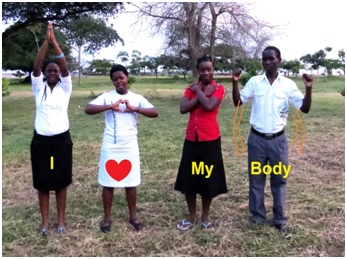 I: Stand tall with both arms touching each other straight up in the air
Love (=heart-shape): Do the ‘love’ by make a heart shaped form with your fingers and your thumbs of both your hands. See the example how to make a heart with your hands.
My: Embrace yourself
Body: put your arms in the air and shake your body
- After practising tell the students to say the words out loud and simultaneously write ‘I love my body’ with their body. First they practise, after that, repeat the game and speed
| Teacher Tips |
|---|
|
When time allows, try the alternative warming-up described below as well. The alternative warming-up consists of more intense body movements. |
Wrap Up
Wrap up I (do this one if you don’t do the second warming up)
Ask the students what they felt in their body and invite them to share their thoughts about what the game is about. Include that you can also use your body to communicate in a non-verbal way. That means showing what you mean by using body language. Not by spelling letters with your bodies!
Option: alternative (or second) warming up- instructions
- Tell the students to stand in a circle.
- Tell the students now to write the words: ‘I ♥ my body’ with their hips. Imagine they are writing on a huge piece of paper that passes through their bodies at their hips.
- Show the students first how to write the letters with their body.
Wrap up II (do this one, if you have done the second warming up)
- The second exercise consists of movements in the hips. Invite them to share their thoughts about what the game is about. Though these are just hip-movements, students might share that the movements look and feel sexual.
- (if you have done both warming ups) Ask the students if they felt a difference in doing the first exercise and the second one.
- Conclude that with a body one can communicate non-verbally, including sexual feelings.
3. Presentation: Body changes + Everyone is unique (30 min)
Materials
Presentation: My body changes + Presentation: everyone is unique –love yourself
When no computer available: Paper version Body Change Game
Extra: Factsheet puberty for boys
Extra: Factsheet puberty for girls
Aim
- Students find out more about the various body changes associated with puberty.
- Students learn about the reproductive organs of the boy and the girl, and their functions.
- Students identify their own feelings as a normal part of this period of growing up and recognize similarities with their peers.
- Students learn that we are all different and should be happy with how we look
How
- Ask students to sit behind the computer in pairs or small groups.
- The presentation consists of slides with information and a body change game.
- Ask students to first read the presentation 'My Body Changes' on the computer immediately followed by the presentation: ‘Everyone is unique- love yourself’. Invite them to and address discussion points included in the presentation with a class mate, before continuing to the next slide.
- In the body change game: Ask students to discuss the right answers with each other, before deciding.
| Teacher Tips |
|---|
|
Wrap Up
Tell students:
Every student changes from child to grown up in puberty, this means that also your body will develop. The body of a girl turns into that of a woman. The body of a boy into that of a man.
A boy’s body changes start most of the time at a slightly later age than those of girls. So that’s why you may see long and feminine girls, and small and boyish boys, while they are actually the same age.
Option: paper version of body change game
The body change game can also be done on paper. Both in plenary or in small groups.
How
See the hand-out on ‘Paper version Body Change game’ for the instructions.
4. Activity: How to support a friend (15 min)
Materials
Top Tip Peer Book
Aim
- The students practice how to support a friend.
How
- Tell the students to think of Tadala and Lonjezo – their peers in the presentation.
Tadala was bullied because she has small breasts, Lonjezo was bullied because of his height. - Ask the male students to pretend Tadala is a very good friend of theirs. Ask the female students to pretend Lonjezo is a very good friend of theirs.
- Tadala and Lonjezo do not like to be bullied any longer. They feel very insecure about themselves and that makes them sad.
- The students need to advice either Chimwewe or Lonjezo on how to deal with their situation. The students do this individually. Ask students to write their advice down in their Top Tip Peer Book. They can create their advice by finishing this sentence: ‘My advice would be…'
| Teacher Tips |
|---|
|
Students write their advice individually. Ask if any of the students wants to share their advice with their classmates and/or to role play their advice in front of the class. In this way students experience how it is to share their advice and actually give advice out loud. |
Wrap Up
Tell students: ‘When your body is developing, you may question if what you go through is normal and natural, and so may your peers. It is very valuable if you support each other in this, as no one feels alien or left out’.
5. Lesson wrap up (5 min)
Conclude the lesson with:
‘Today you have learned more about your body changes and that most young people feel a bit insecure in this phase of life. It is very important to realise that this is the phase of becoming an adult, so something to be proud of. Everybody feels insecure sometimes, so don’t be afraid that you are the only one. You can be proud of yourself, of your body and of who you are! This will help your self-esteem grow and it will be easier to cope with all the changes you are going through’.
6. Homework: Proud to be me!
Material
Top Tip Peer Book
Aims
Students realise how positive it is to think about features of their body or appearance that they are most proud of.
How
- Ask the students to think of one thing about their own body or appearance that they are proud of. It could be anything, like their smile, their eyes, their way of walking, their muscles, their hair, their height or their body shape.
- Tell the students they will not be asked to share their answers with the class. They can keep that to themselves.
- The students have to include their favourite feature in a poem.
- Students write this poem in their Top Tip Peer Book. Students won’t be asked to share this with their families, community or peers. It can remain private if they want.
- Then tell students to become agents of change: students should ask someone in their family or community to think about their own favourite feature and explain why. Students then can explain that focusing on the personal features someone is proud of, makes them feel better about themselves.
For instance a student may ask her mother what she thinks her favorite feature is, and her mother may say: ‘I really like my hair’.
| Teacher Tips |
|---|
|